Clay County voters will decide Nov. 3 whether to renew the school district’s existing 1-mill property tax for another four years. At Tuesday’s workshop, district leaders put numbers behind what they say is at stake: school law enforcement contracts, employee pay and about $21 million a year in local funding.
Clay County, Fla. One number stood out during the Clay County School Board’s Sept. 22 workshop.
Superintendent David Broskie told the board the difference cannot simply be absorbed somewhere else in the district budget.
“You would not be able to retain the current contracts that you have without the one mill funding occurring. That’s a fact. It’s a mathematical fact.”Superintendent David Broskie
A board member put the question to him more directly: Does the district have an extra $8.3 million?
“We definitely do not,” Broskie responded.
That exchange cut to the center of a referendum Clay County voters will decide Nov. 3.
The district is asking voters to renew its existing 1-mill property tax for another four years. District officials said it generates approximately $21 million annually and, under the new ballot language, would be used for two priorities: school safety and employee compensation.
First, what exactly is being voted on?
Quick explainer
- This is a renewal of a mill Clay property owners already pay, not an additional mill on top of the existing rate.
- One mill equals $1 for every $1,000 of taxable property value.
- Spending would be reviewed by an independent citizens’ oversight committee.
District officials emphasized another point Tuesday: the same millage rate does not generate the same amount of money everywhere.
Broskie said Clay’s mill generates about $21 million annually, compared with approximately $63 million in St. Johns County and approximately $111 million in Sarasota County, reflecting differences in taxable property values.
Clay first approved the additional mill following the 2018 Parkland school shooting as districts across Florida faced new school security requirements. It was renewed in 2022 and is now returning to voters in 2026.
This time, the ballot language specifically identifies two purposes: school safety, including law enforcement officers in schools, and competitive compensation intended to attract and retain teachers and staff.
The math behind the school safety argument
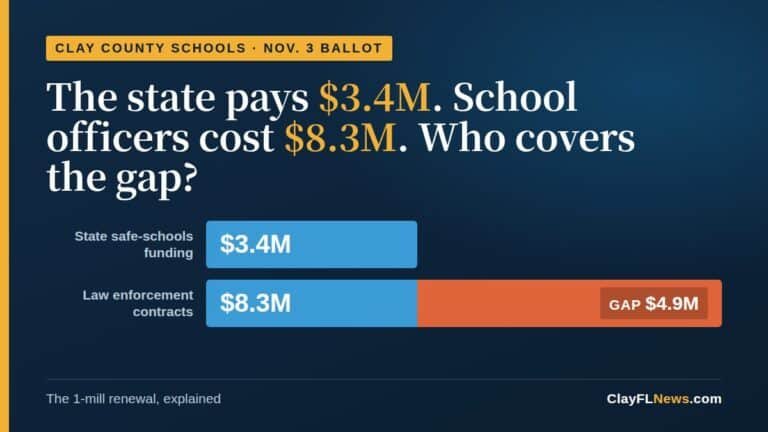
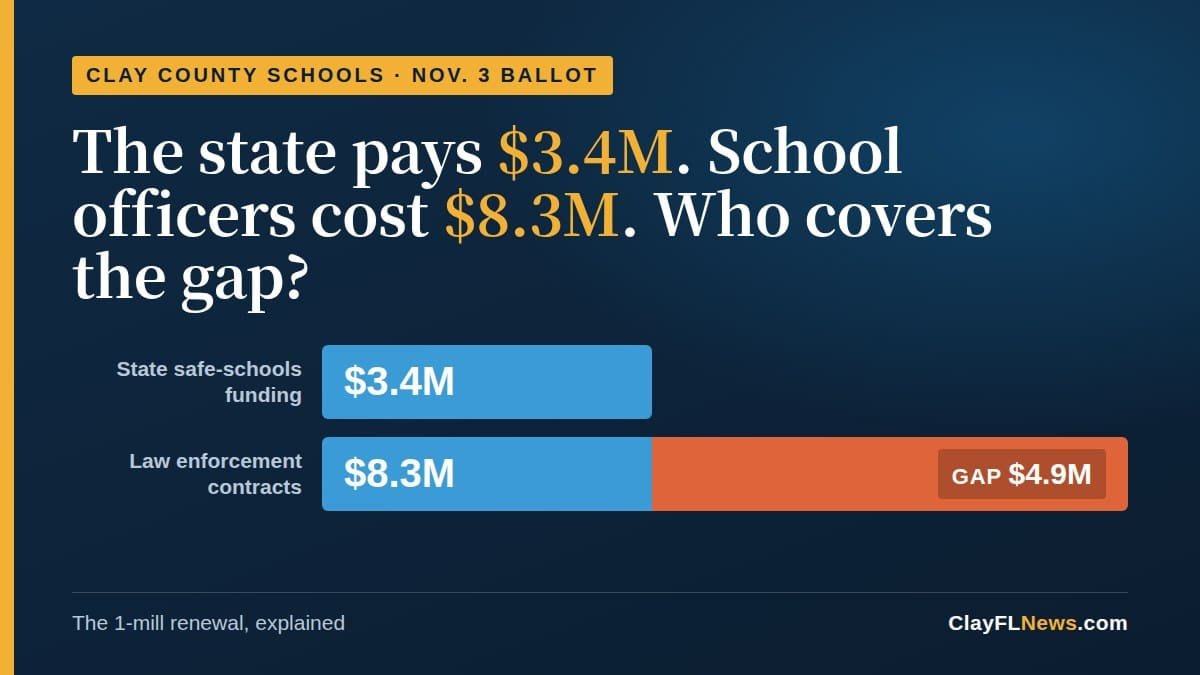
Tuesday’s most consequential discussion centered on the cost of putting law enforcement in Clay schools. According to figures presented by the district, the state safe-schools allocation is about $3.4 million, while estimated law enforcement contracts run about $8.3 million. That is a difference of roughly $4.9 million.
Broskie compared the situation with transportation, another area where he said state funding does not cover the district’s full cost.
“Doesn’t take a rocket scientist to figure out that ain’t good,” he said after showing the two safety figures.
The superintendent praised the district’s relationships with the Clay County Sheriff’s Office and municipal police departments, but said the financial issue remains regardless of the quality of those partnerships.
“The reality is the funding that’s provided in order to support that is not there,” he said.
Then came his clearest statement of the night:
“It’s not a personal thing or anything like that. It’s just math.”Superintendent David Broskie
The second half of the referendum is pay
Broskie then turned to the other use specifically named in the ballot language: employee compensation.
Last year, he said, the district did not have enough money to increase employee compensation or even keep pace with inflation. He called it “a punch in the gut.”
“What makes us a really good school district are the people and the processes that we’ve established within here,” Broskie said.
Then he stopped talking about the referendum as another budget item.
“There’s few times where, as superintendent, I take a step back and maybe because I’m older, I could say, ‘Hey, this is an important moment in the history of our district,'” he said.
“This is an important moment for Clay County Schools.”Superintendent David Broskie
Broskie pointed to district academic results, saying Clay recorded its highest academic performance in district history and ranked first among Florida’s 67 counties in civics.
“This just doesn’t happen like out of thin air,” he said. “Part of it is you have to compensate people that actually do that work.”
He described millage revenue for employee compensation as “a critical piece of the long-term solution for Clay County Schools.”
One board member voted no last time. Now she says she is a “clear yes.”
Perhaps the most revealing exchange did not come from the superintendent. It came from a sitting School Board member.
“I tell people that the last time I voted on the one mill, I voted no,” she said. “I became a school board member one year later.”
The board member said understanding the district budget changed her perspective, but she also pointed to a problem she believed hurt the previous referendum: the ballot language. She said many people she knew voted against the previous measure because they did not understand where the money would go.
She sees this ballot differently.
“This one’s very clear,” she said. “It shows the two things and only the two things that we will spend the money on.”
She said thinking about the measure failing now gives her “a pit in my stomach,” particularly when residents assume sheriff’s deputies would remain in schools regardless of the outcome. She also pointed to years when the district had “zero dollars for teachers, zero dollar for support, zero dollars for bus drivers.”
Then she stated her position:
“I’m a clear yes now because the language is so good that I understand the necessity.”Clay County School Board member
Other board members weighed in
Another member recalled polling conducted while running for School Board and said support for having Clay County Sheriff’s Office personnel in schools was overwhelmingly strong.
“If that is truly a priority, it comes with a price,” the member said.
The member added that the district has been clear that it cannot afford its current arrangement “apart from the millage funding.”
Another board member referenced a figure of 97% support among Clay residents for the Sheriff’s Office presence in schools, although the source and methodology for that polling were not identified during this portion of the workshop.
A different member pointed to the new citizens’ oversight committee as an added transparency measure.
Board members also asked for small informational handouts and QR codes they could carry while speaking in the community.
Educate versus advocate
That request led to an important distinction. District officials discussed what employees and board members can do in their official capacities as the referendum approaches.
The rules for district officials
- They can educate the public about the referendum, including what it funds and what the ballot language says.
- They cannot use their official capacity to tell residents how to vote.
- As private citizens, they can advocate for their own positions.
The district has created referendum information and FAQs through its website and said flyers are also available.
And don’t stop before the back of the ballot
There is another challenge district officials are thinking about: whether voters will even reach the question.
Broskie said the Nov. 3 ballot will be two-sided and the school referendum will appear as the last item on the back.
He raised the possibility of “ballot fatigue,” when voters complete the higher-profile races but stop before reaching questions farther down the ballot.
“It’s important that people finish the ballot, finish strong, at least go to the last one on the ballot.”Superintendent David Broskie
What Clay voters are deciding
Strip away the workshop discussion and the referendum comes down to a handful of numbers:
The School Board and superintendent made their case Tuesday for why they consider the funding important.
The final decision belongs to voters.
Also at the workshop
District considers selling land along SR 220
After the referendum discussion, the board gave staff consensus to continue exploring the sale of a small triangular piece of district-owned property along SR 220 near Swimming Pen Creek Elementary.
An adjacent homeowner approached the district about purchasing the property. Staff said an MAI appraisal valued it at approximately $110,000, and the prospective buyer would pay the appraisal, survey and closing costs.
The district’s condition is that it retain the student sidewalk and fence along the property. Students use the walkway to reach nearby neighborhoods without going through the major intersection, staff and a board member said.
“A lot of younger children use that sidewalk instead of go to the major intersection,” one member who previously worked at Swimming Pen Creek said.
The board reached consensus to continue moving forward as long as the walkway and fence remain with the district.
The property has not been sold. Staff said a formal resolution to dispose of the real property would still have to come before the board.