Two years ago, St. Johns teachers were paid like Clay’s. Then their community changed the conversation. This is the story of how they did it, what the numbers say about Clay today, and the one question that must be answered before November 3, 2026.
Two years ago, St. Johns County found itself facing a problem that sounds familiar in Clay County today.
Teachers were leaving.
In the spring of 2023, starting pay in St. Johns was $47,500, among the lowest in Florida, in the state’s top ranked school district. That year the district lost more than 130 employees. Ninety-two of them were teachers. When contract talks collapsed, a special magistrate reviewed the dispute and sided with the educators, writing that the district’s teachers “have achieved excellent learning results and have thereby earned the pay increases they seek.”
The district’s answer was the same one Clay’s leaders give today: the budget couldn’t support the raises teachers wanted.
The difference is that St. Johns didn’t stay there.
A community decided to invest in its teachers
The change did not begin with the school board. It began with residents.
In October 2022, two years before the referendum, a St. Johns parent started a Facebook group called SOS St. Johns County in response to the teacher exodus and the stalled contract negotiations of that year. Its founders were ordinary residents who began showing up at school board meetings and salary negotiation sessions, and kept showing up. The group was built to be deliberately nonpartisan. Its two lead administrators held markedly different political views, disagreed openly about some solutions, and partnered for three years anyway around the one thing they agreed on: teachers needed to be paid enough to stay. During election season, the group gave every school board candidate the same questions and the same chance to answer them.
That is the infrastructure that existed by the time the district put a referendum on the ballot. A standing community of informed residents, across the political spectrum, who had spent two years learning exactly how school money worked.
In November 2024, St. Johns County voters approved a one mill property tax referendum after district leaders made a public commitment, published on the district’s own website before the election:
“85% of the money will be used for salary improvements to retain and recruit the best staff to serve students. The remaining 15% will support school safety, student welfare, and program enhancements.”
The measure passed with nearly 68% of the vote.
By the following August, teachers were receiving supplements ranging from $4,500 for those in their first four years to $8,888 for veterans with 21 or more years of service, funded by roughly $60 million a year in new, dedicated revenue.
Eighteen months passed between the crisis and the vote that fixed it.
Clay now holds the position St. Johns left behind
According to Florida Department of Education salary data for 2024-25, Clay County has the lowest average teacher salary among its neighboring districts, despite one of the most experienced teaching workforces in the region.
| District | Average salary | Avg. experience |
|---|---|---|
| Duval | $55,279 | 9.3 years |
| Nassau | $54,463 | 11.0 years |
| Putnam | $54,447 | 12.5 years |
| St. Johns | $52,556 and climbing | 12.4 years |
| Clay | $51,074, last place | 11.5 years |
| Florida average | $56,663 | 11.9 years |
Clay teachers average more classroom experience than those in Duval, yet earn about $4,200 less per year.
The district’s own board approved salary schedule shows why the gap widens with time rather than closing:
| Years of service in Clay | Salary |
|---|---|
| Year 1 | $48,500 |
| Year 10 | $49,750 |
| Year 20 | $52,000 |
| Year 29 and beyond | $55,750 |
Starting pay in the two counties differs by only $200. The difference is what each additional year of a career is worth. This is why the teachers leaving Clay are disproportionately veterans, and why 25 resignations appeared on a single school board consent agenda in June.
Is the money being spent somewhere else?
Many residents assume teacher pay is low because too much money goes to administration. State budget filings do not support that conclusion.
| FY2025-26 general fund | Clay | Duval | St. Johns | Nassau | Putnam |
|---|---|---|---|---|---|
| General fund total | $392.5M | $1,501.7M | $569.6M | $162.6M | $113.8M |
| Spending per student | $9,488 (last) | $9,706 | $9,924 | $11,732 | $10,922 |
| Instruction, share of fund | 61.9% | 65.1% | 61.8% | 59.5% | 55.9% |
| Instruction $ per student | $5,870 (last) | $6,316 | $6,129 | $6,975 | $6,101 |
| District administration | 0.16% (lowest) | 0.23% | 0.24% | 0.62% | 0.89% |
Clay runs the leanest central office of the five districts. Its most recent state audit was clean, with no findings. The issue is not unusually high administrative costs. The issue is that Clay has fewer dollars to distribute than its neighbors, and the pool is shrinking.
Why the budget keeps tightening
Like many Florida districts, Clay has seen enrollment decline while education funding follows students to private school scholarship programs and charter schools. District budget briefings show the cost rising sharply:
| School year | Clay funds flowing out to voucher programs |
|---|---|
| 2023-24 | $16.8 million |
| 2024-25 | $24.3 million |
| 2025-26 (projected) | $30.0 million |
Nearly doubled in two years. The district also lost roughly 500 students this year, about $4 million more, while fixed costs for buildings, buses, and utilities stayed the same. It helps explain the district’s $10 million shortfall, last June’s reallocation of some 200 positions, and a reserve fund that state filings show falling from $20.5 million to under half a million dollars in a single budget year.
Put the leak next to the fight teachers waged last fall. They rallied for months, went to impasse, and eventually won a package worth about $4 million. The voucher outflow grew by $7.5 million in a single year. The raise was smaller than one year’s growth in the leak. This is why no version of “cut until raises appear” has worked, and why the one district in the region that solved this problem didn’t cut its way out. It brought in new revenue that stays local. A voted millage remains with the district that levies it.
Clay voters decide on November 3, 2026
On April 2, 2026, the Clay County School Board voted unanimously to place the renewal of its one mill property tax on the November 3, 2026 ballot, for four years beginning July 2027. The resolution, reviewed by this publication, contains the question voters will see:
“To protect students and schools by investing in school safety, including the presence of law enforcement officers in schools, and to support strong academic results by attracting and retaining high-quality teachers and staff through competitive compensation, shall the school district of Clay County renew the existing one-mill ad valorem funding for four years, with all expenditures subject to review by an independent citizens’ oversight committee?”
This is progress. The 2022 version of this ballot mentioned only safety, security, and operating expenses, and records show none of the current mill funds a teacher salary supplement. The 2026 language names teacher compensation in the question itself and adds a citizens’ oversight committee.
Now compare it with what the two counties that out-pay Clay put before their voters:
| Duval 2022 | St. Johns 2024 | Clay 2026 | |
|---|---|---|---|
| First purpose on ballot | Teacher compensation | Teacher pay (in the title) | School safety |
| Published spending split, before the vote | 65% teacher pay + 10% staff pay | 85% salaries | None announced |
| Outcome | Passed. $5,400 supplement per teacher | Passed 68%. $4,500 to $8,888 supplements | Vote: Nov. 3, 2026 |
The pattern in the winning counties is identical: the number was public before the campaign began, so every voter knew exactly what a yes would buy. Clay’s own history shows why words alone are not enough. The 2022 ballot’s “operating expenses” language legally permitted salary spending too, and the current mill funds no salary supplement at all.
One more number reshapes this conversation. A mill is a rate, not an amount. Clay’s mill raises about $21 million a year. St. Johns’ raises about $60 million, because its tax base is three times larger. Because Clay’s mill is the smallest, the share dedicated to teacher pay has to be the largest for the renewal to move salaries at all. At the St. Johns standard of 85%, Clay’s mill would fund roughly $6,400 per teacher per year, enough to lift Clay from last place in the region to the top. At 50%, about $3,800. If the majority goes to safety and security again, teachers get what they got this year: a few hundred dollars.
The raise that isn’t: insurance is about to take it back
There is a second number teachers are watching this summer, and for many it matters more than the raise.
For years Clay’s board absorbed rising health costs rather than passing them to employees. That era is officially over. The district’s own benefits site now confirms it: after nearly 8 years without increases to employee medical contributions, the district’s actuary has recommended an overall 22% increase in medical funding for the upcoming plan year, with final premiums “subject to collective bargaining.”
A rate sheet circulating among employees, whose current-rate column matches the district’s published rates to the penny, suggests where negotiations may land. Premiums are deducted over 20 paychecks, so the math a teacher does at the kitchen table looks like this:
The raise most veteran Clay teachers received: $400 to $800.
The raise 1,200+ newer teachers received: $0.
A teacher covering children on the Choice Plus plan would lose about $3,640 a year. On top of that come a new $35 per paycheck spousal surcharge, a $10 per paycheck surcharge for skipping a wellness assessment, higher emergency room copays, and the loss of no-cost status for some preventive diabetes, asthma, and blood pressure medications.
And there is the timing. Open enrollment runs July 1 through August 4, but the district states that premiums shown during enrollment “reflect current rates” and will increase later. Employees must lock in a year of benefits without knowing what those benefits will cost.
The deductibles deserve their own sentence. Clay’s mid-tier HMO already carries a $5,000 individual and $10,000 family deductible with a $750 emergency room copay. That is the exact deductible St. Johns teachers are currently protesting as unbearable, as a proposal. Clay teachers already live there. In Duval, the high HMO deductible is $1,500, and an employee-only premium costs $35 per paycheck. The proposed Clay HMO rate is roughly four times that.
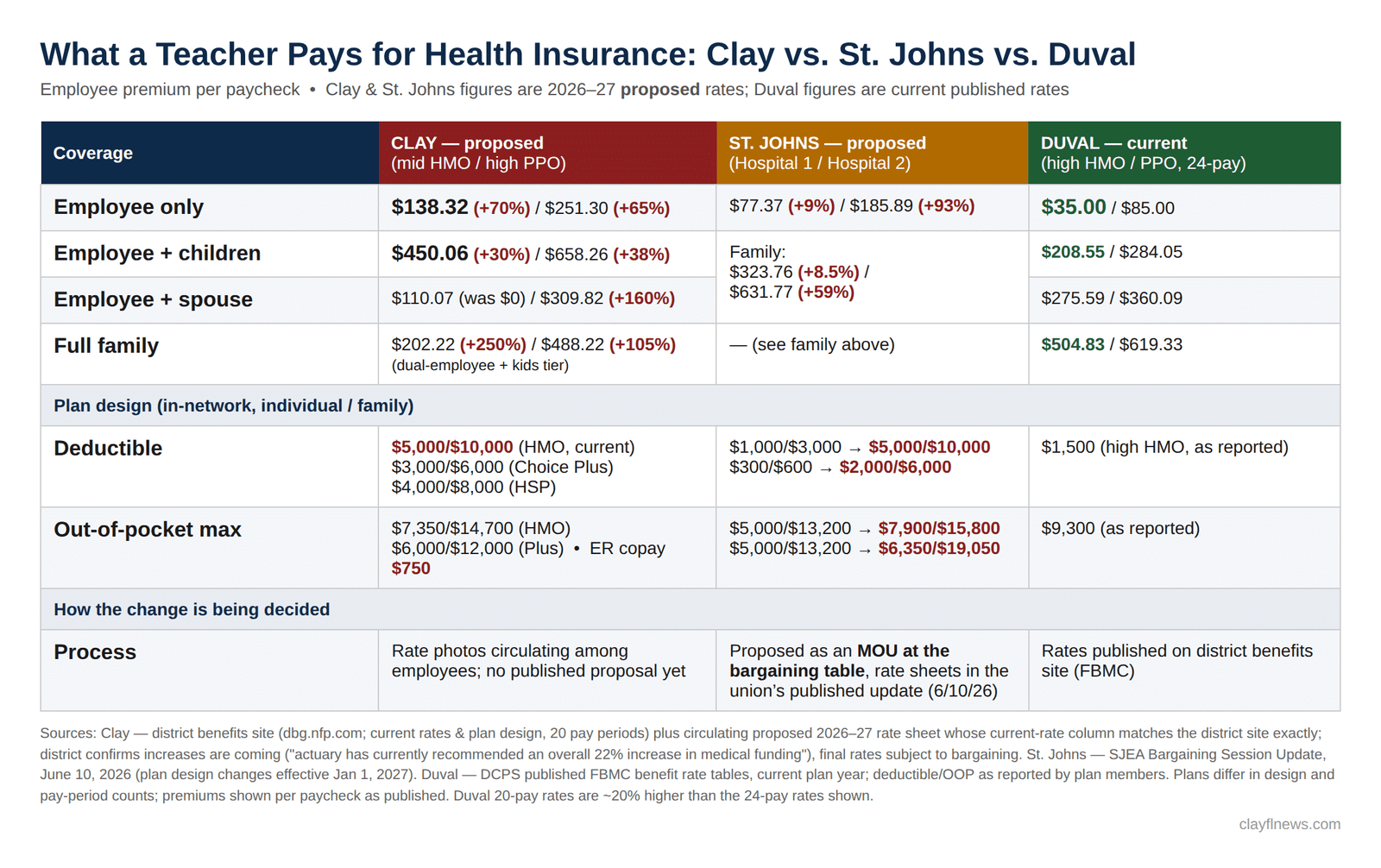
The district promised its insurance switch would save about $3 million a year, yet employees now face a 22% cost increase. The health fund at the center of those increases will not be independently audited this year, because the district is only funding one audit and chose timekeeping instead. Board member Michele Hanson argued the self-insurance fund should be examined, but was overruled.
Seventeen Florida districts found another way. Clay is not one of them.
While Clay negotiates its increases alone, a growing group of Florida school districts has stopped going it alone entirely.
The Florida Educator Health Trust, run by the state’s association of school superintendents, pools districts’ health plans to buy coverage with collective strength: shared purchasing power, flat administrative fees instead of percentage markups, pooled stop-loss protection, and, in the trust’s own words, no hidden agent commissions or backend retention bonuses. Its member list now includes seventeen districts and, per recent reporting, is approaching twenty, covering tens of thousands of employees. Two of them are Clay’s own neighbors: Nassau, which out-pays Clay’s teachers, and Baker are both members, alongside Brevard, Polk, Okaloosa, Collier, and a dozen more.
What does membership look like for a teacher? Polk County, a founding member and by far the largest, publishes its rates:
| Employee-only coverage | Clay (proposed) | Polk (trust member) |
|---|---|---|
| Premium per pay | $138.32 | $0 |
| Deductible (individual/family) | $5,000 / $10,000 | $900 / $1,800 |
Polk’s plan covers the employee at no premium cost, with a deductible less than one fifth of Clay’s. Brevard, another member, charges a single employee about $164 a month on its top plan with a $3,000 deductible. Okaloosa, after moving into self-funding, opened a free employee health clinic this spring with no-cost visits and prescriptions. These districts face the same national health cost pressures Clay cites. They are absorbing them differently.
The savings are not theoretical. Hernando County’s school board voted unanimously in January to apply to the trust, projecting savings of at least 7%, roughly $1.5 million a year, for a district half of Clay’s size. Highlands County joined after its independent plan lost $2 million in a year, and the trust’s pooled stop-loss bidding promptly saved it $328,000 in premium. The trust itself projects 7 to 13% savings for districts that join. Applied to Clay’s roughly $36 million plan, that range works out to $2.5 million to $4.7 million a year. For scale: the raise package Clay teachers fought a year to win cost about $4 million.
Fair notes: those percentages are the trust’s own projections, not audited results, and some boards have hesitated. Hernando members called the trust’s presentation vague before voting yes anyway, and Leon County asked for employee input before acting. Joining is not free money. But seventeen districts, including some of Florida’s most cost-conscious, have judged the pooled model worth it, and members say there are no binding contracts locking a district in. There is no public record that Clay’s board has ever evaluated trust membership, requested a quote from it, or discussed it at a workshop. Clay’s benefits program is instead administered through its longtime commission-compensated broker. An evaluation would cost the district a presentation. Employees facing a 22% funding increase might reasonably ask why it has not happened.
The question worth asking
Duval and St. Johns both told their voters exactly how the money would be spent, 75% and 85% to compensation, in writing, before asking for approval. Both passed. Both delivered supplements within a year.
Clay’s board has adopted ballot language that names competitive compensation as a purpose, but no number.
Regardless of where you stand on taxes or school funding, one question deserves a clear answer before ballots are cast:
Two years ago, St. Johns answered that question before Election Day, because a community of parents, teachers, and neighbors who disagreed about nearly everything else spent two years asking it together, respectfully, at every meeting, until it was answered. Clay’s referendum is just over three months away. In St. Johns, the work started two years out, in a Facebook group, with people who simply refused to stop showing up.
But teachers cannot wait until November. Their classrooms open in three weeks.
Everything above is about ballots, budgets, and next year. This last part is about right now, because right now is where Clay teachers are hurting.
Read this year’s numbers one more time, together. The region’s lowest pay. A raise of $400 to $800 for some, zero for 1,200 more. Insurance increases poised to take back more than the raise. A $5,000 deductible before the plan truly kicks in. And a national survey this year found the average teacher spent $895 of her own money on classroom supplies, up 49% in a decade, while the median school supply budget was $200.
Now put yourself in front of the school supply aisle in late July, holding a teacher’s paycheck.
This is the year the math finally breaks. Teachers who stayed through the shortfall, through the impasse, through the zero-dollar raise are now watching their insurance eat what little they won. They cannot stock their classrooms this August. Not this year. And in three weeks, your child will walk into one of those classrooms.
The referendum will decide whether Clay County finally pays its teachers like the neighbors do. That fight belongs to all of us, and it starts now. But the first bell does not wait for November. Show Clay teachers this month that this community sees them, values them, and shows up for them.
Then share this article with one neighbor. That is how St. Johns did it: one person, telling one more person, who refused to stop showing up.
Sources: Clay County School Board resolution adopted April 2, 2026; St. Johns County School District 2024 ballot language and referendum FAQ; Florida Department of Education 2024-25 teacher salary data and district summary budget filings; Clay County District Schools 2025-26 salary schedule and benefits site; Duval Teachers United pay scales and DCPS benefits rate tables; SJEA bargaining update, June 10, 2026; Florida Auditor General FY2024-25 audit; Action News Jax; First Coast News; News4Jax; Jacksonville Today; AdoptAClassroom.org 2025 Teacher Spending Survey. Clay’s proposed insurance rates are pending final collective bargaining; the district has been asked for comment.