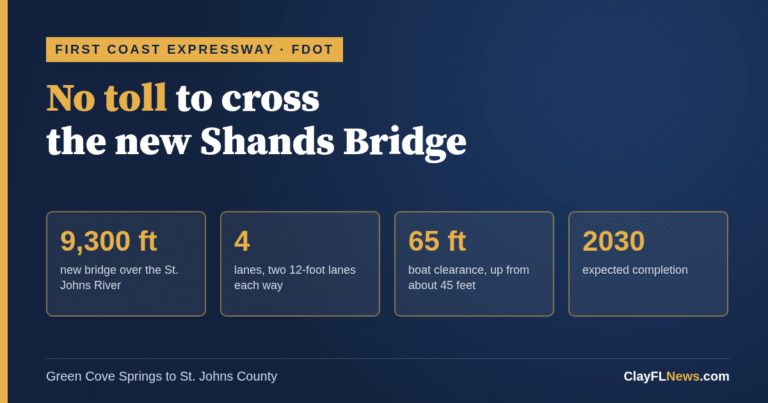
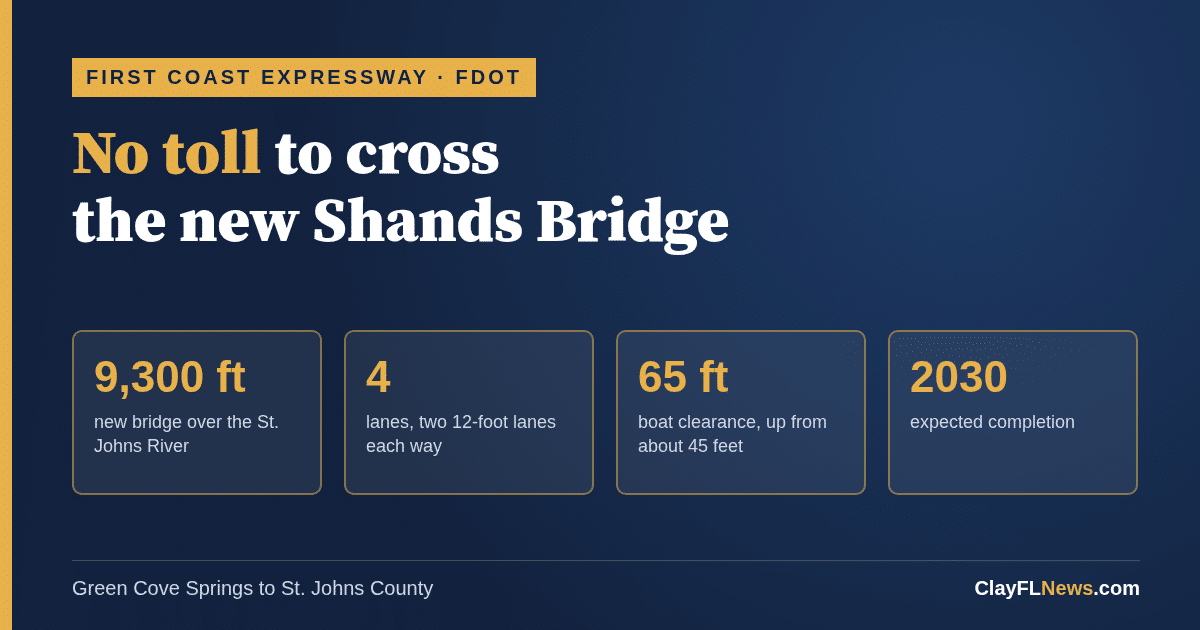
Good news for anyone who crosses the St. Johns River at Green Cove Springs: the new Shands Bridge won’t cost you a toll.
Quick Facts
- Toll to cross the new Shands Bridge: none, per FDOT
- Road: State Road 23, First Coast Expressway, carrying traffic over the St. Johns River between Clay and St. Johns counties
- Length: 9,300 feet
- Lanes: 4, two 12-foot lanes each way, plus a shared-use path on the northbound side
- Clearance: 65 feet, compared with about 45 feet on the current bridge
- Piers: 73, per First Coast News
- Cost: about $595 million
- Contractor: Johnson Bros./American Bridge
- Timeline: construction began May 2023, completion expected 2030
- Old bridge: center removed, both ends kept as fishing piers
- Clay toll at SR 16: $0.65 SunPass, $0.92 Toll-By-Plate (2-axle, May 2026 schedule)
The new bridge will carry the First Coast Expressway (State Road 23), a toll road that runs through Clay County. That has led some drivers to wonder whether they’ll soon be paying to get to St. Johns County. A viewer put that question to First Coast News Traffic Anchor Crystal Moyer, and the Florida Department of Transportation answered it plainly.
“There will be no tolls to cross the river… and you’ll be able to go toll-free all the way across the bridge,” an FDOT senior project manager told First Coast News in a story published Oct. 15.
FDOT also told the station there are no plans for any kind of toll structure on or near the bridge itself. The rest of the First Coast Expressway will be tolled.
Where the tolls are now
The First Coast Expressway has no toll booths. Drivers pass under overhead electronic gantries, and the toll is either taken from a SunPass account or billed by mail through Toll-By-Plate. FDOT says SunPass rates run about 25 percent lower than Toll-By-Plate, and rates are adjusted every year for inflation.
According to the state’s toll rate schedule effective May 2, 2026, these Clay County toll points charge a regular two-axle car:
Clay County toll points, regular two-axle car
| Toll point | SunPass | Toll-By-Plate |
|---|---|---|
| Trail Ridge Plaza | $0.65 | $0.92 |
| Henley Road | $0.65 | $0.92 |
| Sandridge Plaza | $1.62 | $1.89 |
| County Road 218 | $0.65 | $0.92 |
| State Road 16 | $0.65 | $0.92 |
Rate schedule effective May 2, 2026. Trucks and other vehicles with more axles pay more.
The last Clay County piece of the expressway opened June 29. It runs about 3 miles from U.S. 17 to Leonard C. Taylor Parkway at the base of the Shands Bridge, and tolls started the day it opened. First Coast News reported then that the newest sections each add $0.65 with SunPass or $0.92 without. The station put the cost of driving all 37 open miles, from I-10 to the river, at $6.61 with SunPass or $9.31 by plate.
Until the new bridge opens, the existing two-lane Shands Bridge on State Road 16 is still how most people cross the river there, and it has no toll.
The new bridge, by the numbers
FDOT’s project handout describes a 9,300-foot bridge just south of the current one. It will have two 12-foot travel lanes in each direction, 12-foot outside shoulders and a shared-use path on the northbound side for people walking and biking.
The new span will give boats 65 feet of clearance, compared with about 45 feet on today’s bridge. An HNTB senior project engineer told First Coast News that the extra height “is going to allow the Palatka shipyards to grow and expand.” First Coast News reported that 73 large piers will support the bridge.
FDOT lists the cost at about $595 million, with Johnson Bros. and American Bridge as the contractor. Construction started in May 2023, and FDOT expects the bridge to be finished in 2030.
What happens to the old bridge
Once the new bridge opens, the middle of the old Shands Bridge will be torn down. FDOT plans to keep a section on both the Clay and St. Johns sides as fishing piers. Its handout says those spots will get barrier walls, parking, lighting, ADA accommodations and sidewalks.
Driving through the work zone
On the St. Johns side, a temporary traffic pattern started June 29 at the intersection of State Roads 13 and 16 near Orangedale. It sends traffic around a triangle-shaped, counterclockwise loop with one-way legs and new signals on State Road 13. Jacksonville Today reported that the pattern will stay in place until the new bridge is finished. FDOT posts weekly lane closures on its First Coast Expressway project page.
Why it matters for Clay
For Clay County residents who work, shop or go to school in St. Johns County, the old bridge’s two lanes are a daily bottleneck. The new bridge doubles that to four lanes without adding a toll for drivers who just want to cross. The rest of the expressway, through St. Johns County to I-95 near World Golf Village, is also expected to be finished in 2030.