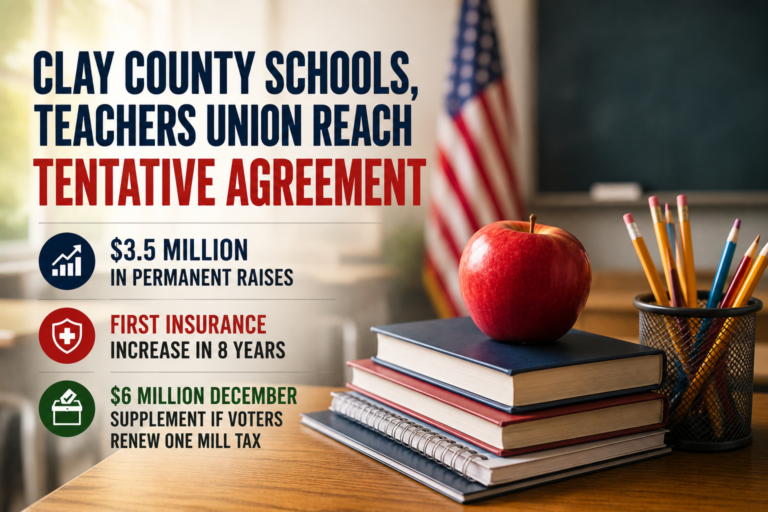
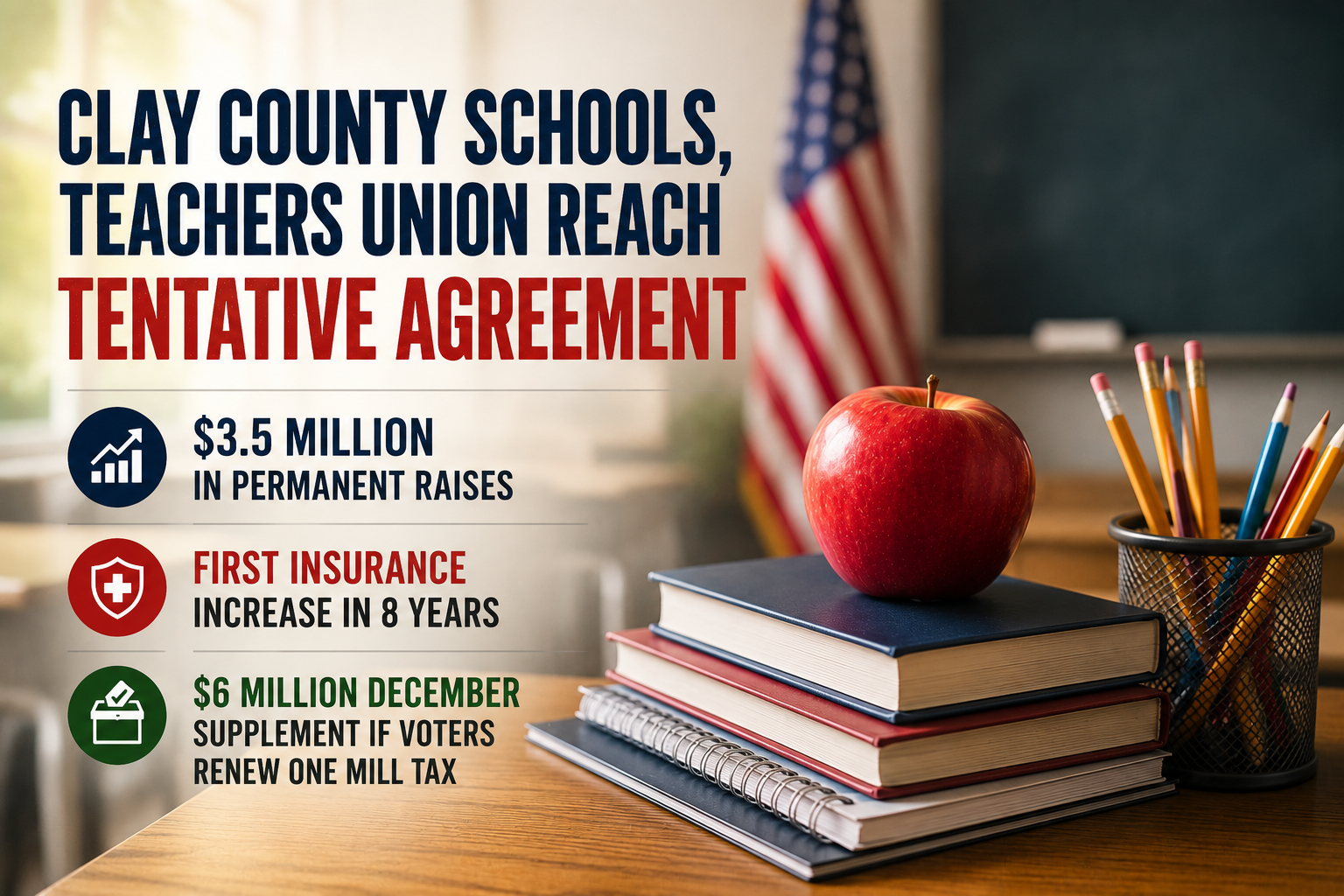
Clay County District Schools and the teachers union signed a tentative agreement July 29: $3.5 million in permanent raises, the first insurance premium increase in eight years, and a $6 million December supplement that only gets paid if voters renew the one mill tax on November 3. The details, from two livestreamed bargaining sessions.
Clay County District Schools and the Clay County Education Association signed a tentative agreement Wednesday, July 29, at the second of two bargaining sessions streamed live on the district’s YouTube channel. Last year the same negotiations went to impasse and the board imposed raises of $400 to $800 on veteran teachers while 45 percent of instructional staff got nothing. This year both sides signed before the first day of school. “It’s absolutely a first for me to have things done” this early, the district’s lead negotiator said at the table.
The deal has three parts. The district called it a package: all or none. The board votes on ratification at its Thursday meeting.
Part one: $3.5 million in raises, permanent, on base salary
| Years of experience | Permanent raise, added to base salary |
|---|---|
| 1 to 9 years | $875 |
| 10 to 14 years | $1,300 |
| 15 to 19 years | $1,400 |
| 20 to 24 years | $1,525 |
| 25 years and above | $1,625 |
Total cost: $3,504,957. That is roughly $400,000 more than the union’s own proposal of $3,117,598, made two days earlier. The district’s opening offer months ago was a one time $600 payment for employees left out of the state’s salary allocation. The final version is recurring, goes on base salary, and counts all years of experience from any state, public or private.
That last piece was the fight. Florida’s Teacher Salary Increase Allocation, worth about $2.38 million to Clay this year ($1.9 million after benefits), only credits classroom teachers with ten or more years in Florida public schools. That excluded guidance counselors, coaches, support facilitators, and anyone whose career crossed state lines. A teacher with 24 years of experience, 15 of them in Florida, would have been paid as a 15 year teacher. The district negotiator called it what it is, on the recording: “It’s a bad rule… we’re a large military town and it left out so many. I sent it to Governor DeSantis as retired military. I thought at least he would listen to that, but it fell on deaf ears.” The deal matches the raise for every excluded group, paid from the general fund. The benefits rate used in the math also dropped from 24 percent to 23.36 percent after the union pushed back, worth roughly $30,000 more in salaries.
The money comes partly out of the district’s fund balance, the same reserve that state filings show near its legal floor. “The board has stretched,” the negotiator said. “It is coming out of the fund balance.”
Part two: premiums rise for the first time in eight years
The numbers behind the increase were laid out at the table. Clay’s health plan is self funded: the district, not an insurance company, pays every claim. “Clay County School Board is the insurance company,” the negotiator said. “Blue Cross Blue Shield only processes the claims. Clay County pays those claims to the doctors, to the hospitals, to the RX, to the labs.”
From October 2024 through January 2026, the top tier Choice Plus PPO plan paid out $6.5 million more in claims than it collected in premiums. It “does not have a green month in it at all,” the district said. The mid tier HMO ran $2.7 million behind. The low tier HSP plan broke even. The union put the combined hole at $9 million. The district currently puts about $31 million a year into the health fund; employees put in $9.1 million.
The district’s actuary recommended a 22 percent funding increase, about $3.84 million each from the district and from employees. The board went against that advice and settled at 16 percent, $2.775 million from each side, gambling that claims come down. “If the claims don’t reduce, we’re going to be in a position to have to do this again next year,” the negotiator said.
A joint committee of CCEA, CESPA, and district staff spent what one member called “three painful hours” distributing the employee share across the plans. The final premium schedule, which will be published with the ratification documents, touches the HSP least, the HMO second least, and puts the heaviest increases on the PPO, the plan running the deficit. Other changes from the sessions:
Copays for primary care, urgent care, and some mental health visits go down. Emergency room copays go up, deliberately: “There are some people that use the emergency room as their primary care.” The pharmacy change that would have ended $0 copays on some preventive brand name drugs is postponed one year, and the benefits office committed to individually contacting affected employees. The free employee clinic, currently open about two days a week, is being negotiated up to five. Employees who enrolled by the August 4 deadline get a controlled enrollment window to switch plans after final premiums are set. Retiree rates were not bargained; retirees were told to contact the insurance office.
The union signed it without pretending to like it. “We still are not happy about it. Our people are not going to be happy about it,” CCEA said at the table, adding that for most employees the increase will not exceed the raise. The district would not commit to that arithmetic for the PPO plan, whose members “have to bear the burden” of the deficit they generate.
Part three: a $6 million supplement, if the mill passes
The third piece converts the referendum from a policy question into a paycheck question.
The district agreed to delay $6 million in safety and security projects and pay that money out as a one year supplement to all employees, around December:
| Years of service | One time supplement (10 month employees) |
|---|---|
| 0 to 5 years | $875 |
| 6 to 10 years | $950 |
| 11 to 12 years | $1,000 |
| 13 to 17 years | $1,100 |
| 18 to 25 years | $1,200 |
| 26 years and above | $1,300 |
Teachers, who make up about 53 percent of the district’s roughly 5,000 employees, get 58 percent of the pool. It counts toward retirement and is taxed as a supplement, not a bonus. Even zero year new hires are included, which the union noted would help offset the new insurance premiums.
None of it is paid unless voters renew the existing one mill property tax on November 3. “If the mill does not pass, then we can’t do this,” the district said, because the delayed safety projects, which include funding tied to the $7.2 million sheriff’s office contract and municipal police contracts, still have to be completed. Both sides said the rest out loud.
The district: “We need every single person to get out and campaign for this… We educate, not advocate. Y’all can advocate. We are counting on you to do so.”
The union, into the camera: “Everyone watching, we need you to vote yes.”
The bigger money comes after. The recordings confirm that a four year agreement dividing the renewed mill’s revenue, roughly $20 million a year, is being negotiated now. The union has submitted proposed tiers, banded 0, 1 to 4, 5 to 9, 10 to 14, 15 to 19, 20 to 24, and 25 plus. The district’s business department is validating the numbers, and the superintendent’s stated goal is to finish before the union’s fall campaign trainings. The district also confirmed the referendum’s ballot language on competitive compensation was written “with encouragement from” the union. This is the written commitment structure Duval and St. Johns adopted before their referendums passed, which this publication has been asking about since spring. The percentage of the mill going to compensation has still not been stated publicly.
Supporters will call the supplement the mill money finally reaching the people the ballot describes. Opponents will note that 5,000 district employees now have a December payment riding on the election. Both are describing the same deal, and all of it was negotiated on a public livestream.
Also in the sessions: reappointment protections, by the numbers
The sessions settled a second dispute worth recording. The union proposed automatic reappointment for annual contract teachers rated highly effective, citing members who say they were non renewed over conflicts with principals. The district countered with data: out of nearly 3,000 teachers, 29 were non reappointed this year, 1.02 percent, and on July 29 broke that number down further. Four were administrators, four were interim contracts, nine were probationary first year contracts. Twelve returning teachers, out of about 3,000, were not renewed. Three probationary teachers were released during the year. The district also disclosed that 578 Clay teachers are in years one through four, and that new teacher coaching positions were eliminated in this year’s cuts, leaving only curriculum coaches.
The compromise, signed as new contract language: when an administrator identifies concerns that do not warrant discipline, the administrator must meet with the teacher in a timely manner, document the conference in the evaluation instrument, and provide “appropriate documented guidance or support.” The union did not get automatic reappointment. It got a paper trail.
What happens next
The ratification package goes to the school board Thursday. Union members vote on the contract after that. Final premium schedules publish with the ratification documents. The four year mill agreement is expected within weeks.
This report is based on the district’s livestreamed CCEA bargaining sessions of July 27 and July 29, 2026, on the Clay County District Schools YouTube channel, and documents presented during those sessions. Quotes are transcribed from the recordings. Speaker attributions follow the meeting introductions; the district’s bargaining team was led by human resources, with CFO participation, and CCEA’s team was led by president Vicki Kidwell and service director Heather Weaver. ClayFLNews’s full reporting series on district finances is available on this site.